Manor Farm, Alton, Hants GU34 3BD
02 Feb 2026

Managing the Countryside for Nature and Public Safety

Recently, we carried out coppicing of some trees beside the road on our farm. We are aware that this has caused concern among some members of the local community, particularly as the work took place along a sunken lane, which is a distinctive and much-valued feature of our area. We would therefore like to explain why this work was undertaken and how such management benefits both wildlife and public safety.

Coppicing is a long-established method of woodland management in Britain. It involves cutting a tree back to its base in order to stimulate new growth from the stool. Far from harming the tree, this process often prolongs its life and encourages healthy, vigorous regeneration.

From our perspective as a farmers and land managers, coppicing plays an important role in supporting biodiversity. When trees are left unmanaged, they can become tall and densely shaded, limiting the growth of plants beneath them. By periodically opening up the canopy, light is able to reach the ground, allowing wildflowers and shrubs to return. These plants then provide food and shelter for insects, birds and small mammals. Many species rely on this mixture of open and sheltered habitat in order to thrive.

There is also an important consideration of public safety. Sunken lanes, by their nature, bring trees and banks very close to the roadway. Over time, trees in these positions can become unstable, overhang the carriageway or restrict visibility. Branches may fall during high winds, and weakened or diseased trees can present a risk to road users and pedestrians. We have a responsibility to manage these risks while preserving the character of the lane.

Some concern has also been expressed about the use of large machinery to carry out this work. In confined spaces such as sunken lanes, modern equipment is often necessary to manage trees safely and efficiently. The use of machinery allows the work to be completed in a shorter period of time, reduces prolonged disruption, and helps ensure that cutting is carried out in a controlled and safe manner for both workers and passing members of the public. While the machinery may appear intrusive, its use enables essential work to be done with the least overall impact.

This work is carried out at appropriate times of year and with careful regard for wildlife, avoiding the bird nesting season. Although the immediate appearance can seem stark, regrowth happens quickly. By spring and summer, new shoots will emerge, and within a few years the trees will once again form a dense and attractive part of the lane.

It is worth remembering that the countryside is not a wilderness left entirely to nature. Much of the landscape we value today has been shaped by active management over many generations. Hedgerows, woodlands and field margins depend on regular care if they are to remain healthy and diverse. Without such intervention, many areas become overgrown, shaded and less beneficial to wildlife.

We care deeply about the land we work and the environment in which we farm. The intention behind this coppicing was not to remove nature, but to renew it: to encourage stronger growth, improve safety and provide better conditions for wildlife. We hope that as the trees regenerate, the long-term benefits of this work will become clear.

Looking after the countryside involves making decisions with future years in mind, even when the short-term appearance may be unexpected. Our aim is always to strike a balance between farming, public safety and the natural environment, so that this landscape can continue to be enjoyed by everyone.
21 Jan 2026

Food or Energy? What Should Our Fields Be Used For?

If you take a walk around our parish, you might notice that some fields don’t look quite the same as they did years ago. Alongside crops grown for food and animal feed, there are now fields growing maize or grass for energy production. That often leads to a simple question, asked in the pub or at the school gate: should farmers be growing food or fuel?

For local farmers, this isn’t a political question, it’s a practical one. Farming has become expensive. Fuel, fertiliser and machinery all cost more than they used to, and the price farmers receive for food can change from year to year. Energy crops, on the other hand, often come with long-term contracts and a guaranteed income. That sort of reliability can make a big difference to a family farm trying to plan ahead and stay afloat.

It’s also worth saying that energy crops aren’t always grown on the best land. Around here we have fields that are heavy, wet, or awkward to farm. These areas may struggle to produce good food crops but can still be useful for energy. In some cases, farms use waste products like slurry or straw to produce energy, so no food crops are lost at all.

That said, it’s understandable that people feel uneasy when good farmland is used for fuel instead of food. At a time when food prices are rising and more people are relying on food banks, it can feel wrong to see crops grown to be burned rather than eaten. There’s also a worry that if we grow less food locally, we end up relying more on imports from abroad.

However, the picture is more complicated than it first appears. Not everything grown on farms is food for people. Large areas are used for animal feed, and a lot of food is wasted somewhere between field and plate. So the real issue may not be energy crops themselves, but how wisely we use what we already grow.

Energy production does have some local benefits. Renewable energy from farms can reduce our reliance on fossil fuels. Anaerobic digesters can reduce odours from slurry and produce fertiliser that goes straight back onto local fields. When done well, this can be good for both the farm and the environment.

Problems tend to arise when schemes are poorly managed. Heavy traffic through villages, muddy roads, soil damage and loss of wildlife are all things people notice quickly. These impacts are felt locally, and it’s right that communities take an interest.

In reality, most local farmers aren’t choosing food or energy. They’re trying to do both. Solar panels on sheds, small wind turbines, and limited energy cropping can help support food production rather than replace it.

In the end, this isn’t just a farming question. What we buy, how much food we waste, and how we support local producers all shape the countryside around us. Our fields reflect our choices, and finding the right balance is something we all have a part in.

21 Nov 2025

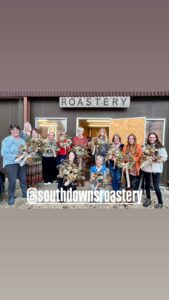
Wreath making workshop at Manor Farm with Blooming Cow Flowers.

Photo from the very successful Autumn wreath making.

There are just a handful of Christmas wreath workshop tickets left… Friday 5th of December from 6.30pm at South Downs Roastery. £45pp link here: https://bloomingcowflowers.co.uk/workshops-%26-events

11 Feb 2025

Its important to Manage Woodland

Management within woodlands (particularly in areas where the Ash trees have been ravaged by ‘Ash Dieback’) can look brutal and change the landscape, but our woods are resilient and bounce back. Most of our woods are Ash and Hazel and these need to be coppiced every 10 – 15 years to keep them looking their best. At Manor Farm we have about 25 acres of woodland including the steep sided hangers which are beautiful but difficult and dangerous to manage.  Its a costly job and we can apply for grant aid which helps a bit. Most of the wood we fell is sold locally or used to fuel the stoves on our Feather Down tents.

We are careful to fell trees selectively.  Managing the trees including rotational coppicing and pollarding will let light through the woodland canopy and encourage revival of the naturally rich ground flora, including bluebells, yellow archangel and wood sorrel. These plants in turn will attract woodland butterflies and other priority species.

You can read more about the woodland work we and our neighbouring farmers do within The Selborne Land Partnership:

https://www.selbornelandscapepartnership.org.uk/current-projects


15 Feb 2022

Spreading the Word.

Something to think about:

Farmers should use less antibiotics, but if your own kitten or dog is sick, go to the vet immediately and give them antibiotics and medicines.

Farmers should not import food but we regularly eat Couscous, Soy, Avocado, Bananas which must be imported into our country.

Farmers pollute drinking water with pesticides. But we shower daily with shampoo, wash medicines down the sink and swim in the pool with chlorine…

Farmers should need less pesticides, but we’re buying strawberries and asparagus in winter because we can’t wait for the season to come…

Farmers should keep as many cattle as they can produce themselves, but we’re bringing the cheaper piece of foreign meat into store because domestic is too expensive.

Farmers would need less or no pesticides and antibiotics if we would buy a curly carrot or apple with brown spots, but we would rather buy the cheaper and more beautiful product in the store.

Yes farmers should change everything… but we are buying more and more foreign products and that is very cheap.

No one cares how much antibiotics or pesticides have been put in where we have no influence on it!

No matter if you fly over the superfood on a plane and spray literally any chemistry on it!

After that, the treated food comes to us by plane or ship….

But we are aware of our ‘environment’

Not only the farmers have to change everything, but much more the consumers!

Let’s finally start with ourselves before we always teach others!

One thing you should never forget, farmers take care of your food, worldwide!

Everyone is responsible for a healthier world.

A piece of awareness can’t hurt.

31 Jan 2022

Round Two of Virtual Farm Tours

Last summer Will did some virtual farm tours with schools.  Beautifully organised by Jo Hatton of LEAF (Linking Environment and Farming). Will has just done another day of tours.  Schools/colleges from Yorkshire, Brighton and South Africa.  Loads of great questions from the sixth formers, fun and thought provoking for all.


03 Feb 2021

Some Science, Interesting Politics and Getting our Food System Right.

 Will’s Online Day:

Every year there is a gathering that happens in Oxford to discuss the current trends and future of our agricultural industry. The Oxford Farming Conference has the mission statements of Inform, challenge and inspire in its logo and this the 75th, certainly didn’t disappoint.

Brexit dominated last years and as nothing had been agreed till just before the title of this years was very apt; Business as Unusual. Of course like so many of these events it had moved onto a virtual platform and I must say didn’t detract too much from the atmosphere of a conference. There was even the facility to network with other delegates in the breaks between lecture’s .

The morning session starts with the politics session. This gives the ministers of the devolved nations their chance to outline future policies and how they might impact the industry. Interestingly George Eustice our current Environment minister chose to boldly give his parties vision of the future with the particular emphasis on technology and how it will benefit the future of food production. The other ministers chose to reassure farmers that policies were there to support the industry through very turbulent times. This different approach by each minister reflects the importance of agriculture to each government.

The trade session had Tim Smith, Chairman of the newly formed Trade and Agricultural Commission previewing their findings. The paper will be launched in February. He was joined by representatives from Arla, Waitrose and Rob Ward who runs an investment fund in Agri tech. Interestingly they all referred to a future culture with sustainability and transparency at the forefront. The other comment worth noting is the customer will be an important part in how trade develops post Brexit.

Commonly known as the ‘Godfather of Sustainability’, John Elkington gave the next lecture. He is well known for his insights into how corporates and supply chains are responding to global sustainability challenges and argues that current practices are not going far enough. He discussed how ‘Regenerative Capitalism’ is changing their mind set’s . I will let you look up the definition but he emphasised this could have big implications on how we produce, distribute and eat food in the UK.

The scene was now set for the science lecture given by Prof Tim Benton who leads the Energy, Environment and Resources Programme at the Royal Institute of International Affairs. His theme was ‘Getting our Food System Right’. He described how our food systems are damaging the planet causing climate change and leading to biodiversity loss, environmental pollution, poor water and soil quality. For me the most profound statement was the damage to our health poor diets was causing. Apparently in 2017 11 million deaths were attributed to poor diets. This is alarming if you compare this with the 1.86 million due to Covid in 2019.

There is a fundamental mismatch in what is grown and what would be an optimal diet. If everybody tried to access all the foods needed for a nutrient rich diet (fruits and vegetables, nut ,fish and pulses) they would be able too. This suggests farming at this moment in time does not provide food that underpins Public Health.

This brings into the question is cheap food really a public good. In simple terms if we had a more varied and wholesome diet this would encourage diversity in crop production and would help create more sustainable food systems. Public Health would be improved and the environmental pressures could be mitigated. We have a long way to go but it feels now we might have the tools to help plot a path and of course we need the consumer to play their part.

Interesting reading

https://www.rethinkx.com/food-and-agriculture