Look our two eggs have hatched. Our licensed owl man from The Hawk Conservancy Council, checked the farm owl box last week and here is one of our fluffy babies.


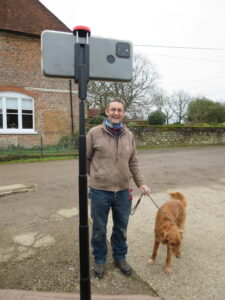
Beautifully organised as usual by Jo Hatton of LEAF (Linking Environment and Farming). Will has just done another full day of tours. Schools/colleges from all round the UK. Will walks with a a selfie stick from the main yard where he talks about our cluster of industrial units, to the cows and sheep and the campsite. Loads of great questions including the usual ‘Is farming hard work’? Well what isn’t?
Something to think about:
Farmers should use less antibiotics, but if your own kitten or dog is sick, go to the vet immediately and give them antibiotics and medicines.
Farmers should not import food but we regularly eat Couscous, Soy, Avocado, Bananas which must be imported into our country.
Farmers pollute drinking water with pesticides. But we shower daily with shampoo, wash medicines down the sink and swim in the pool with chlorine…
Farmers should need less pesticides, but we’re buying strawberries and asparagus in winter because we can’t wait for the season to come…
Farmers should keep as many cattle as they can produce themselves, but we’re bringing the cheaper piece of foreign meat into store because domestic is too expensive.
Farmers would need less or no pesticides and antibiotics if we would buy a curly carrot or apple with brown spots, but we would rather buy the cheaper and more beautiful product in the store.
Yes farmers should change everything… but we are buying more and more foreign products and that is very cheap.
No one cares how much antibiotics or pesticides have been put in where we have no influence on it!
No matter if you fly over the superfood on a plane and spray literally any chemistry on it!
After that, the treated food comes to us by plane or ship….
But we are aware of our ‘environment’
Not only the farmers have to change everything, but much more the consumers!
Let’s finally start with ourselves before we always teach others!
One thing you should never forget, farmers take care of your food, worldwide!
Everyone is responsible for a healthier world.
A piece of awareness can’t hurt.
Last summer Will did some virtual farm tours with schools. Beautifully organised by Jo Hatton of LEAF (Linking Environment and Farming). Will has just done another day of tours. Schools/colleges from Yorkshire, Brighton and South Africa. Loads of great questions from the sixth formers, fun and thought provoking for all.
Inspiration our news page come in many shapes and forms. It may be the time of year, the weather, the future or quite often a question from one of our guests. We have had a busy summer on the campsite and although restricted somewhat by Covid in our interactions there have been lots of questions. A lot is happening in the agricultural world and a lot of it in the public eye.
Thanks to Mr.Clarkson (Clarkson’s Farm on Amazon) the realities of managing a working farm have been brought to a new audience and you’d be hard pushed to find a farmer who didn’t relate to most of the trials Jeremy put himself through. Our guests were very disappointed I didn’t own a Lamborghini and I don’t have a Caleb telling me how to do it. Yes at times there was creative licence but Clarkson did try and portray what most farmers face and was open to the fact that as much as he enjoyed it ,if he didn’t have his extra income from his day job, things would be very tough. This allied to a recent comment I saw “A farm isn’t just a farmer’s workplace, it is his heart and soul”.
Many of the guests had read the reports on recent trade deals with Australia and while at present I do not feel too threatened by them, the precedent set will open the flood gates for other deals that could undermine British Agriculture completely. I appreciate deals like this could work both ways but farming in this country has many more hurdles to jump through that our Australian counterparts don’t, and this is without even touching on their advantages of scale. I’m sure this topic will crop up in future articles, but it is undermining British farmer’s confidence and their willingness to invest in their farming enterprises.
One topic that kept cropping up was carbon trading or offsetting. A few of our guests asked me whether I see our future on the farm as primarily being food producers or will we be sequestering carbon for those industries unable too? Thus offsetting their impact i.e the airline industry. Whilst I am by no means an expert on this subject I think it has along way to go before income is derided from the way I farm, rather than what I produce. We are already someway into our journey of farming in a more sympathetic way and now have an idea of our biodiversity gains but at present this is because I think it is right and the way I like to farm. Whether I will be able to make a living out of it remains to be seen. It was pointed out to me the other day that sequestering carbon will only really slow climate change so if we want to stop it or even reverse it we have to change the way we live or reduce the need to offset it, something for us all to think about.
For those wanting a good read on farming I thoroughly recommend Field Work: What land does to people and what people do to land, by Bella Bathurst.
Throughout a normal year I find myself talking to various groups of children whether guests on the campsite or classes of children. I wouldn’t call myself a natural by any means but with children it is all about keeping it simple.
To break the ice my first question is normally ‘What do YOU think a farmer looks like?’
This normally gets a good response with a good number of hands shooting into the air. Interestingly the answers are always the same – “really old”, “he wears a straw hat”, “always wears wellies”, “grumpy”, “checked shirt”, and my personal favourite, “hairy chest”. And whilst it should be noted that in many cases, they’re quite close to the mark with those descriptions (I confess to owning a few check shirts), it doesn’t really portray the way that we like to see ourselves as part of a modern dynamic and increasingly diverse agricultural industry.
But leaving aside the work we need to do in changing children’s perceptions of us, their answers do often lead me to ponder what the role of a 21st century farmer really is, and whether we’re in the midst of an identity crisis. My father who was born during the war in an era when the British public were still experiencing rationing has always known his role with absolute certainty – to produce as much food as he can, as efficiently as possible. This he has done successfully for his entire farming career, whilst been backed up by Government.
For most of my career, having been taught to farm in that way both at home and college and on other farms, I thought that was my role too. Why would I question it. In the UK we have the climate, the infrastructure, the technology and the expertise which many other countries do not have so we should be pushing on to produce as much as possible to feed ourselves and export any surplus. A simple business decision.
Now being older and hopefully wiser I have questioned whether I was right to follow this path and what is my role from here? You cannot turn back the clock, but what is the role of today’s farmer? Obviously it is to run a profitable business but we must also leave the land in better condition than we found it, and all this while making a positive contribution to reducing climate change.
All three of these aspirations require long term thinking and solutions, from individual farming families, from the wider agricultural industry, and perhaps most crucially of all, from policy makers. Because if we want those things, if we really value our rural communities and our planet and to help them survive and thrive, then we need to look at what’s working and what isn’t, seriously address the barriers we’re facing, and realise the grave consequences of both inaction and getting it wrong.
For most of you who own dogs one of life’s little pleasures at present is the excuse to go for a dog walk and this pleasure hasn’t been wasted on a growing number during the pandemic. The boon in dog sales over the past year has seen more of us take on the responsibility of owning man’s best friend.
Rural areas have seen a huge increase in dog walkers and fundamentally this is to be welcomed but sadly it hasn’t all been plain walking. New statistics from rural insurers show that in 2020, the UK cost of dog attacks on livestock reached an estimated £1.3m – an overall increase of over 10%.
In our locality the incidents are fortunately few and far between. This could be due to the lack of livestock or the fact we have very responsible owners. In a recent survey of dog owners commissioned by NFU Mutual it was revealed that 64% are letting their pets roam free in the countryside, despite half of these owners admitting their dog doesn’t always come back when called.
Attacks are one thing but the damage caused from chasing of sheep at this time of year can have catastrophic consequences on the number of lambs born alive. Also evident in the report was that rather alarmingly, only 40% of the dog owners surveyed accepted that their pet could cause the injury or death of a farm animal only 33% saying they would report an attack taking place to police or a local farmer.
Historically the onus has been on countryside users to follow the countryside code but statistics show this is having little effect and there is now a movement to change the law meaning prosecutions and fines will be given to offenders. This is sad but so is the unbearable suffering of the animal, the anxiety caused to farmers and their families and lest we forget to the dog owners themselves on losing their dog.
As a livestock farmer I have always resisted plastering the countryside in signs hoping it is more welcoming and in fact most of the signs seen locally are more likely politely requesting you to keep off a grass margin. This brings me to gently remind everybody that as spring arrives, please do not forget our hedge line livestock as they too at this crucial time of year, do not respond well to a bit of dog worrying.
Will’s Online Day:
Every year there is a gathering that happens in Oxford to discuss the current trends and future of our agricultural industry. The Oxford Farming Conference has the mission statements of Inform, challenge and inspire in its logo and this the 75th, certainly didn’t disappoint.
Brexit dominated last years and as nothing had been agreed till just before the title of this years was very apt; Business as Unusual. Of course like so many of these events it had moved onto a virtual platform and I must say didn’t detract too much from the atmosphere of a conference. There was even the facility to network with other delegates in the breaks between lecture’s .
The morning session starts with the politics session. This gives the ministers of the devolved nations their chance to outline future policies and how they might impact the industry. Interestingly George Eustice our current Environment minister chose to boldly give his parties vision of the future with the particular emphasis on technology and how it will benefit the future of food production. The other ministers chose to reassure farmers that policies were there to support the industry through very turbulent times. This different approach by each minister reflects the importance of agriculture to each government.
The trade session had Tim Smith, Chairman of the newly formed Trade and Agricultural Commission previewing their findings. The paper will be launched in February. He was joined by representatives from Arla, Waitrose and Rob Ward who runs an investment fund in Agri tech. Interestingly they all referred to a future culture with sustainability and transparency at the forefront. The other comment worth noting is the customer will be an important part in how trade develops post Brexit.
Commonly known as the ‘Godfather of Sustainability’, John Elkington gave the next lecture. He is well known for his insights into how corporates and supply chains are responding to global sustainability challenges and argues that current practices are not going far enough. He discussed how ‘Regenerative Capitalism’ is changing their mind set’s . I will let you look up the definition but he emphasised this could have big implications on how we produce, distribute and eat food in the UK.
The scene was now set for the science lecture given by Prof Tim Benton who leads the Energy, Environment and Resources Programme at the Royal Institute of International Affairs. His theme was ‘Getting our Food System Right’. He described how our food systems are damaging the planet causing climate change and leading to biodiversity loss, environmental pollution, poor water and soil quality. For me the most profound statement was the damage to our health poor diets was causing. Apparently in 2017 11 million deaths were attributed to poor diets. This is alarming if you compare this with the 1.86 million due to Covid in 2019.
There is a fundamental mismatch in what is grown and what would be an optimal diet. If everybody tried to access all the foods needed for a nutrient rich diet (fruits and vegetables, nut ,fish and pulses) they would be able too. This suggests farming at this moment in time does not provide food that underpins Public Health.
This brings into the question is cheap food really a public good. In simple terms if we had a more varied and wholesome diet this would encourage diversity in crop production and would help create more sustainable food systems. Public Health would be improved and the environmental pressures could be mitigated. We have a long way to go but it feels now we might have the tools to help plot a path and of course we need the consumer to play their part.
Interesting reading