Cock of the Castle

For most of you who own dogs one of life’s little pleasures at present is the excuse to go for a dog walk and this pleasure hasn’t been wasted on a growing number during the pandemic. The boon in dog sales over the past year has seen more of us take on the responsibility of owning man’s best friend.
Rural areas have seen a huge increase in dog walkers and fundamentally this is to be welcomed but sadly it hasn’t all been plain walking. New statistics from rural insurers show that in 2020, the UK cost of dog attacks on livestock reached an estimated £1.3m – an overall increase of over 10%.
In our locality the incidents are fortunately few and far between. This could be due to the lack of livestock or the fact we have very responsible owners. In a recent survey of dog owners commissioned by NFU Mutual it was revealed that 64% are letting their pets roam free in the countryside, despite half of these owners admitting their dog doesn’t always come back when called.
Attacks are one thing but the damage caused from chasing of sheep at this time of year can have catastrophic consequences on the number of lambs born alive. Also evident in the report was that rather alarmingly, only 40% of the dog owners surveyed accepted that their pet could cause the injury or death of a farm animal only 33% saying they would report an attack taking place to police or a local farmer.
Historically the onus has been on countryside users to follow the countryside code but statistics show this is having little effect and there is now a movement to change the law meaning prosecutions and fines will be given to offenders. This is sad but so is the unbearable suffering of the animal, the anxiety caused to farmers and their families and lest we forget to the dog owners themselves on losing their dog.
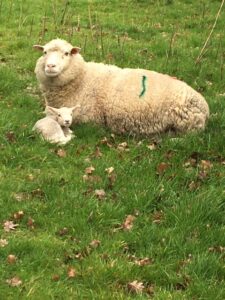
As a livestock farmer I have always resisted plastering the countryside in signs hoping it is more welcoming and in fact most of the signs seen locally are more likely politely requesting you to keep off a grass margin. This brings me to gently remind everybody that as spring arrives, please do not forget our hedge line livestock as they too at this crucial time of year, do not respond well to a bit of dog worrying.
Will’s Online Day:
Every year there is a gathering that happens in Oxford to discuss the current trends and future of our agricultural industry. The Oxford Farming Conference has the mission statements of Inform, challenge and inspire in its logo and this the 75th, certainly didn’t disappoint.
Brexit dominated last years and as nothing had been agreed till just before the title of this years was very apt; Business as Unusual. Of course like so many of these events it had moved onto a virtual platform and I must say didn’t detract too much from the atmosphere of a conference. There was even the facility to network with other delegates in the breaks between lecture’s .
The morning session starts with the politics session. This gives the ministers of the devolved nations their chance to outline future policies and how they might impact the industry. Interestingly George Eustice our current Environment minister chose to boldly give his parties vision of the future with the particular emphasis on technology and how it will benefit the future of food production. The other ministers chose to reassure farmers that policies were there to support the industry through very turbulent times. This different approach by each minister reflects the importance of agriculture to each government.
The trade session had Tim Smith, Chairman of the newly formed Trade and Agricultural Commission previewing their findings. The paper will be launched in February. He was joined by representatives from Arla, Waitrose and Rob Ward who runs an investment fund in Agri tech. Interestingly they all referred to a future culture with sustainability and transparency at the forefront. The other comment worth noting is the customer will be an important part in how trade develops post Brexit.
Commonly known as the ‘Godfather of Sustainability’, John Elkington gave the next lecture. He is well known for his insights into how corporates and supply chains are responding to global sustainability challenges and argues that current practices are not going far enough. He discussed how ‘Regenerative Capitalism’ is changing their mind set’s . I will let you look up the definition but he emphasised this could have big implications on how we produce, distribute and eat food in the UK.
The scene was now set for the science lecture given by Prof Tim Benton who leads the Energy, Environment and Resources Programme at the Royal Institute of International Affairs. His theme was ‘Getting our Food System Right’. He described how our food systems are damaging the planet causing climate change and leading to biodiversity loss, environmental pollution, poor water and soil quality. For me the most profound statement was the damage to our health poor diets was causing. Apparently in 2017 11 million deaths were attributed to poor diets. This is alarming if you compare this with the 1.86 million due to Covid in 2019.
There is a fundamental mismatch in what is grown and what would be an optimal diet. If everybody tried to access all the foods needed for a nutrient rich diet (fruits and vegetables, nut ,fish and pulses) they would be able too. This suggests farming at this moment in time does not provide food that underpins Public Health.
This brings into the question is cheap food really a public good. In simple terms if we had a more varied and wholesome diet this would encourage diversity in crop production and would help create more sustainable food systems. Public Health would be improved and the environmental pressures could be mitigated. We have a long way to go but it feels now we might have the tools to help plot a path and of course we need the consumer to play their part.
Interesting reading
It’s good to talk about the technology available in the farming industry and whether a farmer of a certain age has the skills to cope with it. I for one fit that category and although it makes me nervous I am keen to embrace it and excited that it could take our industry into new and exciting times.
Last month I had the pleasure in delivering a lecture outlining my business to a group of year ten students in Cumbria. This you may wonder is a departure from my day job but is an example of technology in use.
Farming as an industry has an alarming problem in that its core work force has an average age of 56 yrs old. I luckily fall below that, just, but if we are going to embrace this new technology we must have an industry attractive for generations to come.
Over my farming career the industry has reduced its workforce drastically. Efficiencies have made us competitive and helped bring down the price of food. The cost of land makes it very difficult for new entrants and a lot of the roles on a farm are regarded as menial and low paid.
I have over the years been very open with our farm. In the early years we were proactive in giving farm walks to our customers from our butcher’s shop in Alton, primarily to give them the confidence to buy a genuine product but also to help them understand the process.
With our glamping site we show over a thousand people a year around the farm primarily to get them to appreciate their surroundings but also to send them away with a confidence to buy British.
Over the years I had hoped that some of my younger audience will have been inspired to think of Agriculture as a career as the industry cannot rely on a bunch of fifty year olds. This brings me back to my venture into lecturing.
Last Autumn I approached an organisation called LEAF(Linking Environment and Farming ) about linking up with local schools. LEAF has recently merged with FACE(Farming and Countryside Education).The primary goal is to inspire and educate future generations about farming, food and the countryside. Working with a regional consultant the aim was to link up with local schools and hopefully deliver a series of inspiring farm visits.
Sadly we haven’t been able to deliver yet but Jo my regional consultant has been proactive on Facebook and promoted the idea of doing this remotely and I as a willing volunteer, offered to do the first one. The process is remarkably simple and involved two people, a selfie stick ,a willing group of students and of course well behaved animals. We finished with a question and answer session which was a bit like being thrown to the dogs but I survived and will be better prepared next time.
Ultimately my point to this article is that with the industry changing and embracing new technology hopefully we will be an attractive career choice to the next generation and I for one am keen to inspire them.
Further reading